In the hallowed halls of academia, the “final boss” has traditionally been the defense panel. However, as we navigate the 2026 academic landscape, a more insidious adversary has emerged: the digital threat actor. The evolution of university thesis submissions from physical bound volumes to sophisticated digital repositories has unlocked unprecedented accessibility, but it has also turned scholarly intellectual property (IP) into a high-value target for cybercriminals. From ransomware attacks on university servers to the surreptitious theft of pre-publication research, cybersecurity is no longer a niche IT concern—it is the foundation of modern academic integrity.
As institutions transition toward “Open Science” and cloud-based submission workflows, students are finding themselves on the front lines of data protection. Navigating these complexities requires precision; many students now look to specialized myassignmenthelp experts for thesis writing service support that integrates robust data encryption and secure research methodologies. Ensuring that your breakthrough findings remain yours until the moment of publication is a logistical feat that mirrors the security protocols of Fortune 500 companies.
The Escalation of Academic Cyber-Espionage
Why would a hacker want a Master’s thesis on 2D materials or a PhD dissertation on behavioral economics? The answer lies in the “Long Game.” State-sponsored actors and corporate spies often target university repositories because they contain the blueprints for future technologies. According to a 2025 Cybersecurity in Higher Education Report, intellectual property theft in academia has risen by 40% year-over-year. Research projects, often funded by multi-million dollar grants, represent a goldmine of unpatented data.
When the pressure of these security demands becomes overwhelming, many students choose to do my college assignment for me via professional platforms to ensure their work is managed within a secure, encrypted environment. This isn’t just about academic assistance; it’s about safeguarding years of labor against the volatility of local hardware failures or campus-wide network breaches.
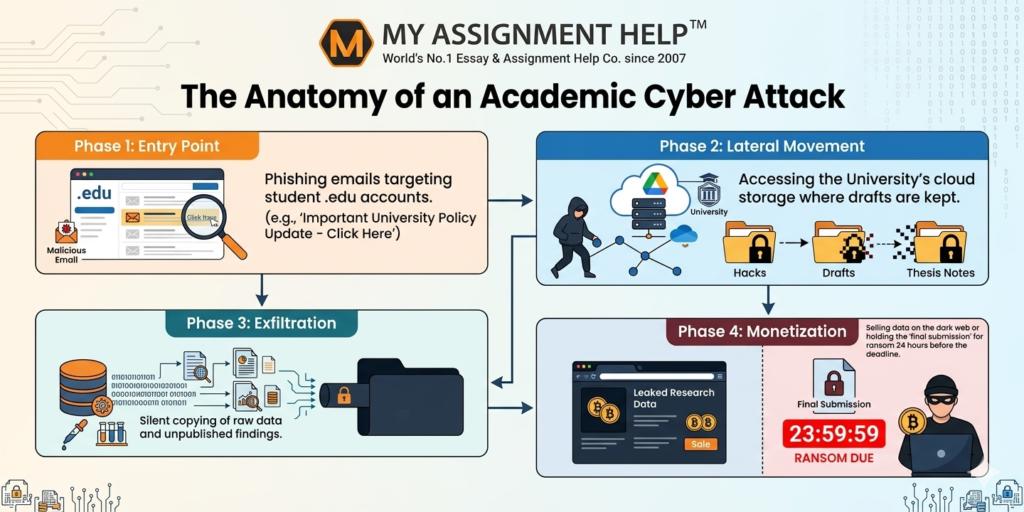
The Ransomware Threat: The Night Before Submission
Imagine spending three years on a doctoral thesis only to find your files encrypted by “LockBit” 48 hours before the hard deadline. This isn’t a hypothetical horror story; it is a recurring reality. Universities are “soft targets” because of their decentralized networks.
| Statistic | Impact Value |
| Ransomware Attacks | 64% of universities hit in the last 18 months |
| Average Recovery Cost | $1.2M for academic data breaches |
| Data Loss Frequency | 1 in 5 students report losing data due to lack of cloud security |
AI, Deepfakes, and the Identity Crisis
The rise of Generative AI has introduced a new layer of cybersecurity: Veracity Security. How does a university prove that the person submitting the thesis is actually the student? Identity spoofing and deepfake-assisted defenses are emerging threats. Senior content strategists now emphasize the importance of “Digital Provenance”—a secure trail of document versions that prove the evolution of a thesis over time. This audit trail is the only defense against accusations of AI-generated fraud.
Best Practices for Securing Your Thesis
- End-to-End Encryption (E2EE): Use tools like ProtonDrive or VeraCrypt for storing raw data sets.
- Multi-Factor Authentication (MFA): Never rely solely on a password for your university portal.
- The 3-2-1 Rule: Keep 3 copies of your work, on 2 different media types, with 1 kept off-site/offline.
- Digital Watermarking: Embedding invisible identifiers in your drafts to track leaks.
Key Takeaways
- IP Theft is Real: Digital repositories have turned student research into high-value targets.
- Time-Sensitive Attacks: Hackers often strike during the final submission window to maximize leverage.
- Beyond Local Storage: Relying on a laptop or a single USB drive is a major security risk for E-E-A-T compliance.
- Provenance is Proof: Maintaining a secure digital trail protects you from AI-related academic integrity investigations.
Frequently Asked Questions (FAQ)
Q: Can my university be held liable if my thesis is stolen from their server?
A: Legal precedents are shifting, but generally, universities have limited liability clauses. Students are increasingly responsible for their own data “hygiene” and pre-submission security.
Q: Is cloud storage like Google Drive safe enough for a PhD thesis?
A: While convenient, standard cloud storage lacks the “Zero-Knowledge” encryption needed for sensitive or high-value intellectual property.
Q: How does cybersecurity impact my thesis grade?
A: Indirectly, a breach can lead to a “missing” file or a leak that triggers plagiarism flags. Both scenarios can be catastrophic for your GPA and graduation timeline.
Author Bio: Sarah Jenkins
Sarah Jenkins is a Senior Academic Consultant at MyAssignmentHelp with over 12 years of experience in educational technology and content strategy. Specializing in academic integrity and digital security, Sarah helps post-graduate students navigate the technical hurdles of high-stakes submissions. She is a frequent contributor to journals focusing on the intersection of AI and pedagogical ethics.
References & Data Sources
- IBM Security (2025): Cost of a Data Breach Report.
- Journal of Higher Education IT (2024): The Rise of IP Theft in Post-Graduate Research.
- Cybersecurity & Infrastructure Security Agency (CISA): Protecting Academic Intellectual Property Guidelines.
- HESA (Higher Education Statistics Agency): Digital Transformation Trends in US/UK Universities.


